
Congratulations, you're programmed! Here's how to break free...
What we think are our own thoughts and narratives are often manifestations of modern algorithmic curation.

THE NARRATIVE
You are living life manipulated. Read that again.
This newsletter issue is not about one narrative, per se, more an observation on how our technology feeds us increasingly polarizing ones.
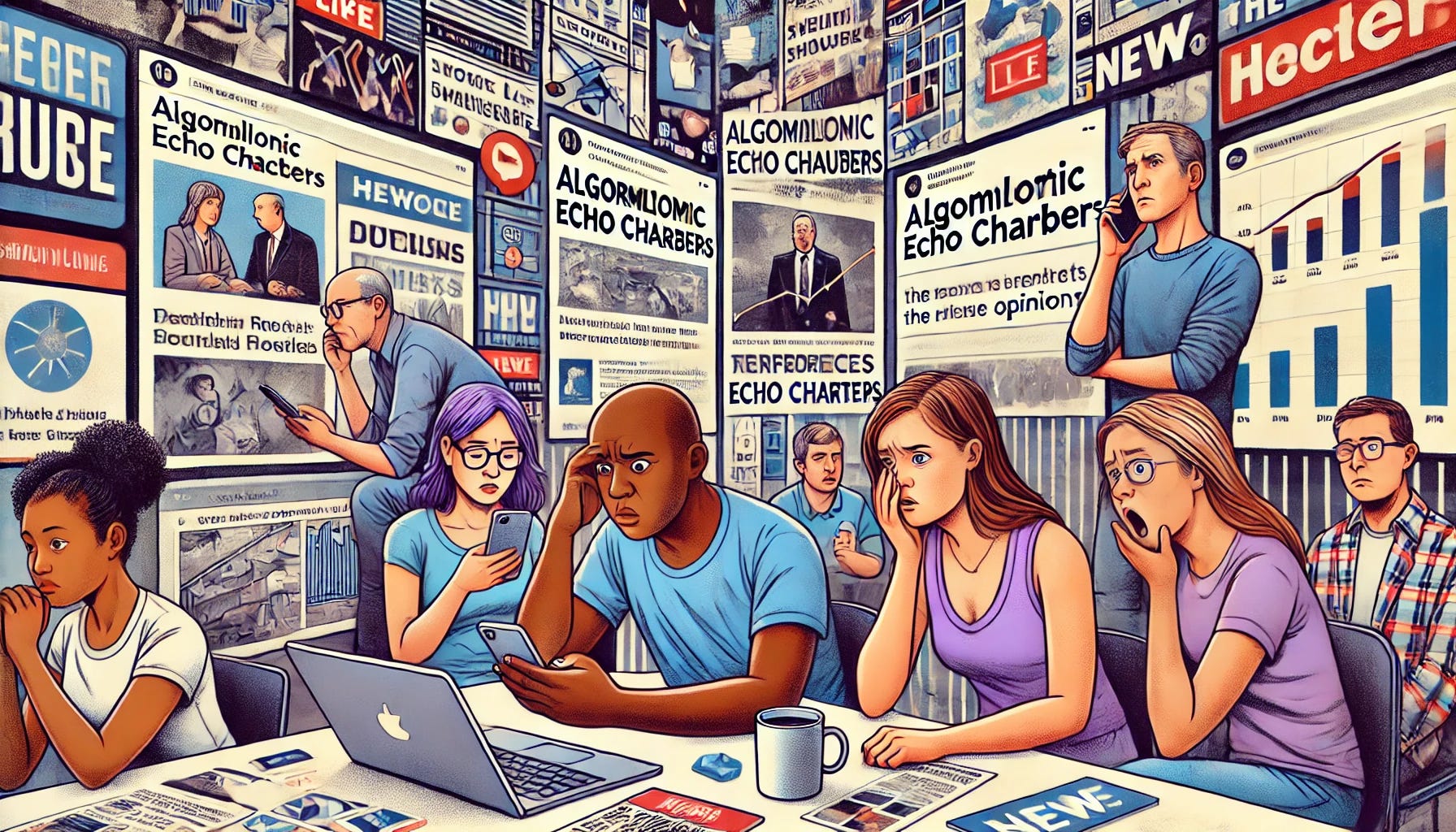
Our continued adherence to common narratives (especially political) is reinforced by the invisible hand of algorithmic curation, where social media platform algorithms systematically select, organize, and prioritize content for us. Unlike traditional human-driven editorial processes, where someone like me curates content to be a broader mix of topics and ideas, the algorithm tends to move in the direction of your preferences.
The result is echo chambers or “reality tunnels” where the most emotionally polarizing content gains top place. The same social media platform that shows you a steady feed of luxury travel destinations also shows your family members the latest DOGE conspiracy theories about government collapse. Both are very different worlds, yet stem from the same source.
THE DECONSTRUCTION
Algorithms are processes or rules followed by a computer as it problem-solves. For both social media and search engines, they're used to quickly disseminate a large amount of information by retrieving the most relevant at lightening speed for a particular user. They shoulder a dual responsibility: to present you with the content you're seeking and to achieve a programmed objective like maximizing engagement in the form of clicks, likes, and shares. Hence why you are served content out of nowhere similar to what you have consumed before.
Remembering that an algorithm is mainly mathematical and not imbued with evil properties as conspiracy theories suggest is essential. Although they are oblivious to the fragmentation woes they've caused, they've reshaped political discourse and cultural trends, narrowing our horizons while giving us the illusion of expansiveness. Rather than a shared conversation, there are millions of micro-conversations happening simultaneously.
Social media is the main driver of news sources according to Pew Research Center’s fact sheet. Just over half of U.S. adults (54%) say they at least sometimes get news from social media, up slightly compared with the last few years. Facebook and YouTube (algorithm central) outpace all other social media sites as places where Americans regularly get news, serving about a third of U.S. adults.
Other manipulative aspects of this algorithm mind-f$%! include:
The illusory truth effect: the tendency for people to perceive information as more truthful when it is repeated, regardless of whether it is actually true or not.
Confirmation bias: giving content that aligns with existing beliefs the driver’s seat.
Truth bias: believing people are telling us the truth, even when we have evidence to the contrary.
Flash trends (are you very demure, very mindful?): intense but short-lived cultural moments on TikTok, Instagram, or other platforms that swarm our feeds until they fizzle out.
REFRAME, REFINE, REWRITE
Obviously, this issue is much broader and more complex than a simple newsletter article. My goal is to inform you with an overview and then offer you ways to shift and evolve past the noise.
If you remember anything from this article, then remember this: moderate or centered voices are often lost in the fray because an algorithm can’t get the engagement metrics it craves from them. This is unfortunate because they are more voices of reason capable of grounding polarized narratives into practical concepts. Alas, they don't trigger the engagement metrics that extreme content beckons.
I hate to say it, but there is no quick fix, not even in the tech itself. I can tell you as a user to be more vigilant, but chances are you will just scroll through your feed after a long day. Being vigilant is extra work. So, how can you peel back the layers of manipulation?
Diversify Your Information Sources: I can't stress this point enough! Getting all your content from one social platform or source is an echo chamber. Subscribe to publications with different editorial stances, follow thought leaders from various backgrounds (even ones you disagree with), and deliberately explore viewpoints that differ from yours.
Read more long-form: I am biased here because I am a journalist who writes long-form. Even though it gets fewer clicks than TikTok and is so laborious to produce that I've questioned my masochistic tendencies, long-form journalism offers deeply researched and sourced perspectives on something critical. You'd rather get the full scoop than a comment or two to form an accurate narrative about the subject matter. It will make you smarter and more of a critical thinker.
Boundaries, boundaries: Create clear parameters around your media consumption. Establish specific times for checking news and social media, and stick to them. That includes scrolling in bed when you first wake up. (I am guilty of this as well.) Use technology tools like app blockers or screen time limits. Consider implementing a "digital sunset" where you disconnect from information sources at least an hour before bedtime, allowing your mind to rest and process the day's insights.
Practice emotional intelligence in media consumption: Recognize how media affects your emotional state. Be aware of content that triggers anxiety, anger, or despair. Journalists are guilty of propagating negativity, I know. However, you can seek solutions-oriented journalism and content that highlights problems and explores potential positive approaches. Balance your intake of challenging news with content that inspires, educates, and uplifts.
Cultivate deep Learning and slow Media: Choose long-form journalism, in-depth documentaries, and comprehensive books over quick info-snacking. Prioritize quality over quantity, spending more time with fewer, more substantive sources. Consider adopting a "slow media" approach that values depth, context, and thoughtful analysis over constant updates and breaking news.
If you want to dive deep into the concept of info-snacking, you can watch my 2023 Creative Mornings Munich talk below.
In our current media landscape, the quality of your information diet is just as crucial as the food you eat. You want both your mind and body to be optimal.
Until next time info warriors,Jessica
Want more?
Feeling stuck? Talk to me via a one-on-one advising session or hire me to consult here.
Join the community. Follow @narrativedive on Instagram, TikTok, or YouTube. You can also add me on LinkedIn.
Listen up. Narrative Dive is also a podcast available on YouTube, Spotify, Apple Podcasts, and other major platforms. Each episode features in-depth conversations with distinguished experts who discuss common narratives present in their field.
Sources:
Sound advice in here — especially about not scrolling the first thing when you wake up. Guilty as charged. I’v tried but failed to stick to the whole “charge your phone in another room overnight to avoid scrolling” guidance. Maybe it’ll stick one of these days…